
Putting a Support System in Place
For many people navigating the criminal legal system, the level of support they receive following pretrial release can determine whether they remain in the community or cycle back into custody. They’re often faced with urgent and legally binding obligations, including court dates, court-ordered conditions, and programs that must be attended. When people fail to meet these requirements, it’s usually because of logistics. They might lack transportation, be unable to pay program fees, be confused by paperwork, or have no access to a computer.
In April 2025, the Superior Court of Alameda County, California, responded to this reality by opening its first Pretrial Resource Center. They quickly followed suit with two more. “We now have three Pretrial Resource Centers—two in Oakland and one in Dublin,” explains Cory Jacobs, the program manager for Pretrial Services with the Superior Court of California in Alameda County. These physical, courthouse-based spaces are designed to help people meet court-ordered obligations by removing the barriers that make compliance difficult or impossible. Rather than emphasizing surveillance or enforcement, the centers focus on service navigation, individualized support, and access to resources during the pretrial period.
Jacobs says the push to expand pretrial services was driven by data, particularly recidivism rates among moderate-risk individuals. “We were seeing very high recidivism rates, higher than what you would expect,” she explains. When the team looked closer, they saw a pattern: people released with service-based conditions had low compliance rates and relatively high rates of new arrests. Her argument to county partners was straightforward: “We’re releasing people to the same circumstances they were in when they were arrested…sometimes worse. And then we’re expecting a different outcome when we haven’t changed anything about their circumstances.”
“We’re releasing people to the same circumstances they were in when they were arrested…sometimes worse. And then we’re expecting a different outcome when we haven’t changed anything about their circumstances.”
Cory Jacobs, pretrial services program manager, Superior Court of California in Alameda County
The centers aim to disrupt this cycle with a new approach. “We’re not supervising people; we’re supporting them,” says Jacobs, “And we use a ‘whatever-it-takes’ approach.”
Removing the Barriers to Compliance
The Pretrial Resource Centers are part of Alameda County’s broader pretrial reform efforts, aimed at reducing new arrests during pretrial release and improving community safety by making sure people can realistically comply with the conditions judges impose. The centers serve people released on nonfinancial conditions like court-ordered treatment participation, counseling, or educational programming.

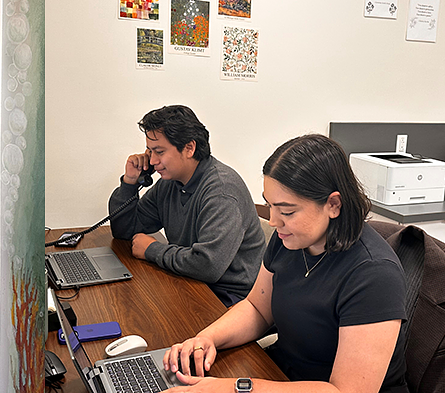
What sets the model apart is the way support is delivered. When someone walks into a resource center, law enforcement isn’t the first thing they encounter. Instead, they’re greeted with a place to sit, free snacks, water, and a calm moment to regroup. This welcoming environment is intentional. Each visitor is then paired with a staff member for one-on-one support.
“When someone comes in, they’re the most important person in the room,” Jacobs explains. “That’s typically not the experience people have in the court system, and we’re trying to change that.” Next, staff focus on making compliance more achievable. Jacobs describes the process: “We complete referrals on-site, sometimes doing intakes by phone while they’re here. Then, we assess basic needs like housing, food, clothing, and hygiene. Everyone leaves with a visitor summary showing what we helped with, their next appointments, hearing dates, attorney contact info, transportation plans, and enrollment reminders.” People can return as often as they need, even if it’s just for a bus pass or a check-in.
Making Court Orders More Achievable
The resource centers are designed to help people understand and follow through on release conditions. Many clients arrive without a full understanding of their court-ordered obligations or without key paperwork. To help them, staff review their conditions and clarify expectations. “When the courts give people nonfinancial conditions that they don’t have the resources to comply with, it’s not very different from setting a bond amount they can’t afford,” Jacobs states.
To bridge this gap, the centers provide a variety of hands-on support, including:
-
- Helping people navigate referrals to court-ordered programs
- Contacting and enrolling people in classes and programs
- Paying for required classes, therapies, and programs
- Providing transportation assistance (e.g., bus passes)
- Offering laptops and internet access for virtual programs
- Helping people contact their attorneys
- Addressing basic needs such as clothing, hygiene supplies, food, and water
“If the court is telling you to do something,” says Jacobs, “we believe it’s our responsibility to make sure you actually have what you need to do it.” The centers also serve people who haven’t been formally ordered into a program. Jacobs says that if someone has a pending case and wants help, including treatment, counseling, or employment support, staff will assist with enrollment and even cover the cost. Participation doesn’t have to be mandatory to be supported.
“When the courts give people nonfinancial conditions that they don’t have the resources to comply with, it’s not very different from setting a bond amount they can’t afford.”
Cory Jacobs, pretrial services program manager, Superior Court of California in Alameda County
This flexibility is backed by a network of community-based providers. As of the end of 2025, Alameda County had contracts with seven providers that offer services including sober living housing, outpatient treatment, anger management, parenting classes, domestic violence counseling, batterer’s intervention programming, DUI classes, and employment support.
Reducing Missed Court and Unnecessary Jail Stays

Missed court dates commonly result in bench warrants and rearrest during the pretrial period. Research consistently shows that failures to appear are usually tied to logistical barriers rather than an intent to flee.[1] “Most people who miss court are not hiding,” Jacobs points out. “They just couldn’t get there or didn’t know about their warrant.”
The resource centers try to stop that chain reaction before it starts. They also serve as a safe space for people who have already missed court or who have outstanding warrants.
“People are scared once there’s a warrant out, and now they don’t know what to do,” Jacobs explains. “The resource center gives them a safe place to come where no one is going to arrest them, and we can help them get back on the calendar.”
Early Outcomes and Future Plans
Jacobs says the program focuses on two key outcomes: new arrests and court appearances. In her view, those are baseline measures any pretrial program must take seriously: “At a minimum, we should be preventing new arrests and failures to appear. If we’re not doing that, then what are we doing?”
Although still early in implementation, Jacobs says the team is seeing patterns that reinforce the model. The resource centers have been highly effective for many lower-risk individuals and have also shown promise for higher-risk people when staff can quickly connect them to stable services. Jacobs shared one example that captures how the model works in practice:
In August 2025, a man walked into the resource center the day after being released from custody. He was unhoused, didn’t have a phone or belongings, and had been ordered into outpatient substance use treatment but had no way to enroll or even a place to sleep.
Staff completed his intake on-site and worked with a provider to place him in a sober living bed that same day. Once stabilized, he was connected to outpatient treatment. Months later, the man was still housed, still engaged in the program, and had just resolved his case. He wasn’t rearrested and didn’t miss court, despite being assessed as higher risk, with prior felony and violent felony convictions.
He wasn’t on supervision or monitoring. We just gave him safe and stable housing and access to the services that he needed, and it worked.
At the same time, Jacobs has been paying close attention to cases where resource centers alone aren’t enough—particularly with people who need sustained, hands-on support after leaving the courthouse. That’s one reason Alameda County plans to expand the model.
Since opening, the centers have operated with a lean staff of trained interns. In 2026, the county will add case managers and intake coordinators. Case managers will work with people for the duration of their release terms and also meet them out in the community. “Some people need more than a resource center. They need someone to meet them where they are,” explains Jacobs.
Takeaways for Other Jurisdictions
By removing barriers, providing access to resources, and humanizing the pretrial process, Alameda County’s Pretrial Resource Centers offer a repeatable model for other places seeking to improve their own pretrial outcomes and community safety. According to Jacobs, the centers were shaped by national research on successful models from other jurisdictions. Others can learn from the best practices she’s applied, including:
-
- Pair conditions with compassionate, accessible support to increase compliance
- Provide basic necessities and make centers feel warmer and more inviting than traditional court settings
- Provide one-on-one attention and clear next steps to help people stay on top of their conditions
- Use warm handoffs rather than cold referrals to increase engagement
- Track your outcomes, including court appearances and recidivism trends
- Plan for different levels of need, ranging from day-of assistance to ongoing case management
Making support a pretrial strategy can result in fewer community members failing to meet conditions and fewer people landing back in jail. “This work is about humanizing the court process,” states Jacobs. “When you give people the tools they need, they show up.”