For Mary Hoskins, the Queens Supervised Release (QSR) program has been a lifeline. At age 60, Hoskins (whose name has been changed to protect her privacy) had struggled with decades of opioid addiction and criminal-legal involvement. Her husband had recently died of an overdose.
Then, in April 2024, QSR’s intensive case management team met Hoskins at her felony arraignment hearing, where she was released into the program’s supervision. A QSR peer specialist, who had her own experience of addiction recovery, took Hoskins out to coffee. A housing specialist found her a transitional apartment, and the team helped her obtain health insurance and a state ID. Hoskins agreed to enter an outpatient drug treatment program and attend 12-step meetings with her peer specialist. She has reported being in recovery since November 2024.
“She was really able to rely on us for support and care,” said Trish Ortiz, director of clinical and peer services at New York City’s Criminal Justice Agency (CJA), which runs QSR.
QSR provides services to people released pretrial; just a few years ago, many of these people may have been detained or had money bond set for their charges. Hoskins’ experience demonstrates the groundbreaking steps QSR takes to support clients’ success and improve pretrial outcomes.
“We’re building relationships with people, spending a lot of time with them, understanding what their needs are, and trying to help them navigate those needs.”
Joann DeJesus, Executive Director, Supervised Release
After New York state changed its laws governing the use of financial conditions and pretrial release, QSR had to adapt rapidly. The changes, implemented in January 2020, resulted in a massive increase in the volume of clients mandated to QSR for pretrial supervision. The program has done remarkable work within its means, training specialized staff and piloting community-based, multidisciplinary teams that provide care and aftercare for clients with a range of serious needs. Despite limited resources, QSR is successfully supporting people’s pretrial responsibilities, such as attending court hearings, complying with release conditions, and remaining law-abiding.
“We’re seeing people who have severe mental illness, substance use issues, and a lot more homelessness, housing instability, and food instability,” said Joann DeJesus, CJA’s executive director of supervised release. “We’re building relationships with people, spending a lot of time with them, understanding what their needs are, and trying to help them navigate those needs.”
Scaling Up
Established in 2009 by CJA, QSR originally served only people charged with nonviolent felonies but later expanded to accept those charged with misdemeanors. In 2016, the mayor’s office scaled the program up citywide, assigning a different provider for each borough. QSR staff used a pretrial release assessment tool to determine who would be accepted into the program. At the time, the program accepted people with a relatively high likelihood of returning to court; people could also opt out of the program. By 2019, QSR served close to 900 people each year.
When New York’s pretrial changes took effect, the laws made supervised release mandatory for many more people. QSR initially expected to serve around 2,500 clients each year, quadrupling its previous projections. But it far surpassed that number, and today serves 7,000 people annually, addressing an array of serious needs.
“We have no ability to say no to the courts or close our doors,” DeJesus said. “So, we just have to manage the volume as it comes in.”
New Models for Pretrial Success
QSR created new structures for staff and clients alike.
Staff Training
New training for case managers, clinical supervisors, peer specialists, and peer supervisors helps staff better support client needs.
“We have to train our staff differently, because clients are coming in with a lot of mental health issues, at times even decompensating[a] in the waiting room,” said Misha Nonen, CJA’s chief program officer for QSR. “So, the way we run the program has changed vastly.”
The training includes de-escalation, harm reduction, and trauma-informed practices for people who face drug dependency and past trauma. This helps QSR’s crisis team manage serious and potentially volatile situations
QSR has recently begun training staff in a cognitive-behavioral therapy (CBT) approach that has shown promise in a Baltimore program. To understand where clients are in their individual process, the program uses the University of Rhode Island’s “readiness-to-change” questionnaire. Motivational interviewing, a communication style designed to bolster people’s commitment to change, also helps staff guide clients toward self-determined goals.
Intensive Case Management
On the programmatic side, the intensive case management (ICM) model that helped Hoskins stabilize her life is a pilot project for high-need clients. Launched in early 2024, ICM focuses on people with repeated criminal-legal involvement who struggle with problems like housing instability, mental illness, and substance use. The community-based care team includes clinical social workers, case managers, housing specialists, behavioral health staff, and peer specialists, all of whom maintain lower caseloads so they can devote more attention to each client. Since its inception, 1,023 people have been enrolled in the ICM program.
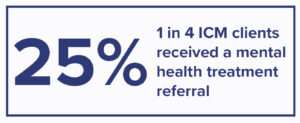 As in Hoskins’s case, the ICM team typically meets clients immediately after they are released to supervision, where a social worker performs a “mobile intake” to determine their needs. ICM provides basic necessities, like Metrocards, meals, and help with obtaining vital documentation, as well as with greater needs like housing assistance and connection to care. Credentialed addiction counselors help get clients into treatment. The team has a van and often schedules supervision meetings at a person’s home, a library, or a local park instead of in the office, making it easier for clients to show up. Together, these measures add up to a coordinated care plan, with services that give clients the greatest chance of success.
Aftercare
Launched in 2025, one of QSR’s most recent initiatives is the aftercare model, which supports clients’ goals after their cases are disposed—whether the final outcome is a dismissal of charges, a guilty plea, or going to trial. This model is a response to a challenge: As New York courts continue to reduce processing times, driven by speedy trial and discovery reforms, QSR has less time to work with clients. But while clients’ court outcomes may be resolved, the stability that clients are working toward—such as securing housing, sustaining recovery, or gaining steady employment—rarely fits inside that shortened window.
The aftercare team continues working with clients on a voluntary basis for up to four months beyond case disposition. Using the readiness-to-change model, the team reviews each client’s action plan every 20 days to measure progress. If a client has moved from one stage to another—for example, from accepting treatment to maintaining consistent sobriety—QSR views that as progress. To date, 73 people have participated.
Assigning the Right Level of Supervision
Research shows that over-supervision can create unnecessary obligations for clients on top of family responsibilities, full-time jobs, and other treatment programs, setting them up to no-show for appointments and fail the program through technical violations. In the landscape following New York state’s law change, one persistent challenge is that judges often order a higher level of supervision than recommended by CJA’s validated pretrial release assessment. This creates a resource strain, pushing a higher caseload onto already overburdened case managers and staff.

To address this challenge, QSR educates judges about supervised release. In 2025, CJA conducted a validation of its pretrial release assessment, which showed that the tool is highly accurate at estimating whether someone will return to court if placed on the recommended level of supervision. Staff members meet periodically with the judiciary, sharing information about the reliability of the assessment tool and anecdotes about clients who have struggled when the supervision level is too demanding for their needs.
“We find that that has an impact,” DeJesus said. “They hear us loud and clear.” Often, the courts will then mandate the recommended level of supervision for a time.
Moving forward, QSR staff plan to rely more on evidence-based models like CBT and to use data to guide their practices. The aim is to better serve clients, help them find stability, and contribute to greater community safety.
Hoskins hopes to contribute in her own way. She is currently completing a bachelor’s degree and is becoming a certified peer specialist—an effort to do the very work that has helped her. “So many participants have gone on to get peer certified or enter other helping roles,” Ortiz said. “The support they got is something that they want to give to someone else.”