In 2016, Damon Drake was working on an initiative to provide alternatives to incarceration in Ramsey County, Minnesota, when he conducted a survey to better understand community perspectives on the local justice system. Local Black, Hmong, and indigenous groups overwhelmingly named two problems: When they were innocent, they had limited means to defend themselves, and when they were found guilty, the punishments were too severe.
Drake saw a TEDx Talk by Raj Jayadev that introduced him to the idea of “participatory defense,” a community organizing approach that helps families of people facing criminal charges take actions that can positively impact the cases of their family members. Jayadev developed the approach in San Jose, California, with his organization Silicon Valley De-Bug, and he was working to replicate the model across the country.
“I was really inspired,” Drake says. “I had the belief that we could do something like that.”
“When we go into courtrooms, we normally see a white judge, a white prosecutor, and a white public defender, and then a Black defendant in the middle, watching like it’s a tennis match, but a tennis match that decides their freedom. We don’t believe that should be happening. We believe that families and the community bring valuable information, support, and resources in order to defend our loved ones.”
A growing number of jurisdictions have implemented participatory defense in recent years to address the dual concerns expressed by respondents to Drake’s survey. First, during the pretrial phase, when a person charged with a crime is legally considered innocent, participatory defense enables that person and their family members to advocate for the least restrictive release conditions. Research shows that unnecessarily onerous conditions don’t improve pretrial outcomes—appearing in court and remaining arrest-free—and may actually make it more difficult for people to meet their legal and personal obligations. Harsh release conditions can also result in unintentional detention. Even a single day of detention leads to worse case outcomes, harsher sentencing if convicted, and an increased likelihood of missing court or being rearrested. Second, participatory defense provides a path to argue for less severe sentencing if the person is deemed guilty.
The immediate goal of participatory defense is to address these two issues—especially for Black and brown people, who face disproportionate exposure to the criminal legal system. The long-term aim is to transform power dynamics in the courts.
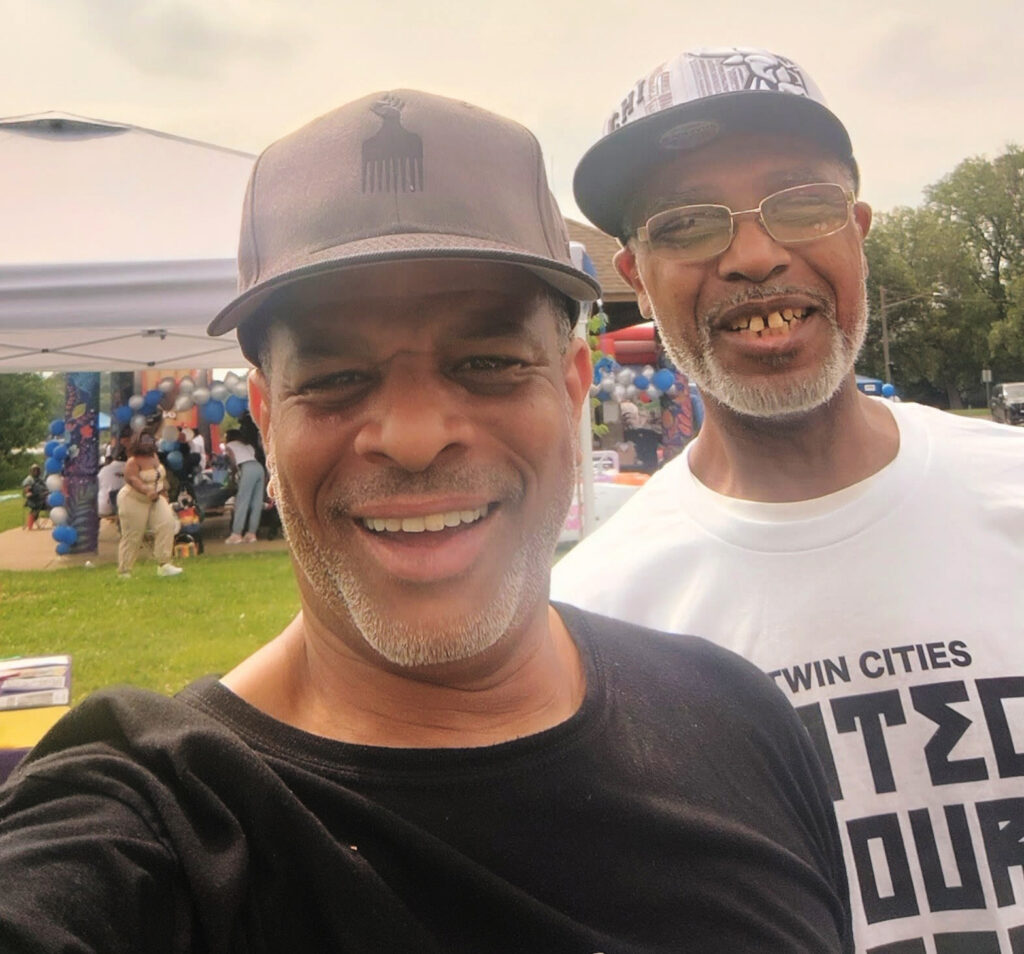
In September 2020, Drake launched We Resolve Minnesota, a participatory defense hub serving Ramsey County and the surrounding region. He and his staff completed a multi-day training with De-Bug and worked with organizers from Silicon Valley, Knoxville, Tennessee, and Philadelphia. They learned how to build a team, show up for people in court, and run meetings, along with a number of other essential elements of the model.
Elements of Participatory Defense
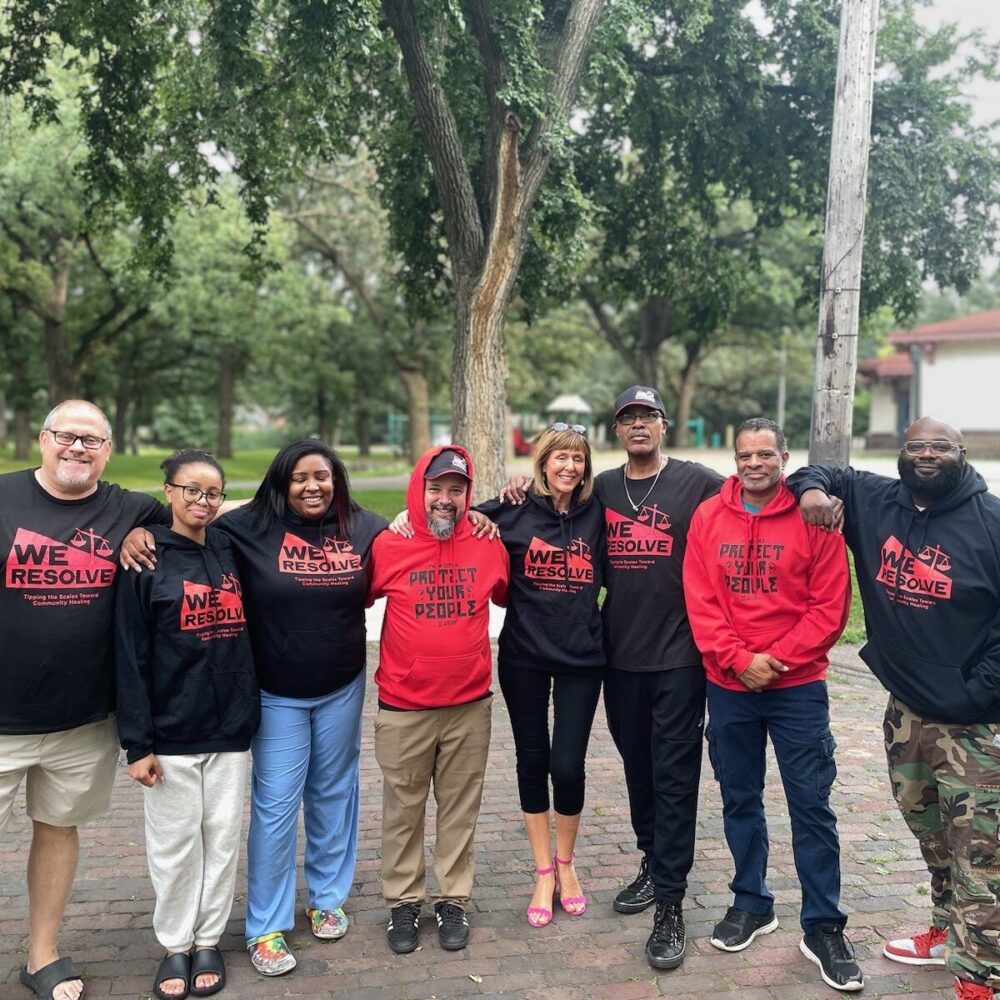
Today, when family members of people charged with crimes call We Resolve, they reach De’Marcos Shaw, one of the organization’s seven community resolvers—staff members who have faced their own cases and now mentor others.
Shaw himself was an early beneficiary of We Resolve’s work. Unable to pay a $75,000 financial release condition, he spent close to a year in jail before being referred to Drake. With the help of Shaw’s daughter, We Resolve prepared his social biography and spoke on his behalf at court dates. He was eventually convicted, but as a result of Drake’s advocacy, he received a relatively light sentence of probation, mandatory treatment, and weekly We Resolve meetings. Today, his probation officer advocates for his early discharge from probation, in part because of his good work in the community.
“I was fighting for my life, and it felt really good to have someone who didn’t even know me stop what he’s doing to advocate for me,” Shaw says. “It feels good when I do it for someone else now.”
Shaw learns about each new client’s case and directs them to resources.
“I was fighting for my life, and it felt really good to have someone who didn’t even know me stop what he’s doing to advocate for me. It feels good when I do it for someone else now.”
De’Marcos Shaw, We Resolve Community Resolver
One such resource is The First 24 Hours tool, which helps families locate where their loved one is being detained, deliver their medications, set up visits, put money in their jail commissary accounts, learn when their first court appearance will take place, and understand what documents they will need. This information also helps Shaw or one of the other community resolvers advocate for the person. They show up for the arraignment hearing, speak to the person’s attorneys and the judge, and often organize community volunteers to appear as court watchers.
Another key part of the participatory defense model is the “social biography,” in which community resolvers gather letters from family and friends with information about a person’s background. The biography often details the person’s responsibilities at home, such as providing a grandmother’s insulin shots or picking up a younger sibling from the school bus. Families may provide photos of the person with their children during better times. This biography, which can be used in pretrial testimony, helps humanize people in the court’s eyes and, ideally, helps secure their pretrial release and reduced sentencing if convicted.
The approach has measurable impacts. We Resolve’s work regularly results in shorter (or no) time in pretrial detention, and it can lead to reduced sentences—along with associated taxpayer savings—as well.
“That translates to folks who are at home with their families, picking up their kids, making dinner, contributing to society, doing what’s best for them and their community,” Drake says.
Whatever the individual outcomes, We Resolve is there to support families as they navigate what can be a harsh and discriminatory process. Each Tuesday, the organization holds meetings where families and people released from detention share food, updates about their legal issues, and connections to community resources for everything from bail assistance to housing, employment, transportation, and addiction and mental health treatment.
“The folks who show up, they don’t feel judged in any way, because everybody who’s there has been through it, either ourselves or somebody in our families,” Drake says. “We’ve got nothing but compassion.”
Working Within the System
Integral to We Resolve’s success are the strong relationships that Drake and his team have formed with other system actors who find value in the participatory defense model. Greg Egan, a public defender and member of the We Resolve board, says that community resolvers help defense attorneys get better results for clients. His office works directly with We Resolve to gather humanizing information about clients’ backstories, which helps attorneys make arguments to prosecutors and judges about the individual and community impact of decisions related to release and conditions of release.
Egan can also call We Resolve to find mentors for young clients who will help them show up to court, an approach that reduces missed court hearings. At times, community resolvers can even find witnesses or others with insight into a case, since they may have more credibility in communities of color than public defenders do.
“Some of the value comes down to relationship building,” Egan says. “Despite our best efforts at community relations, there are often negative stereotypes that attach to public defense, and community resolvers can vouch for us when we deserve it, and help break down some of those institutional biases.”
On the other side of the courtroom, Ramsey County Attorney John Choi is also a strong supporter of participatory defense. Choi says that prosecutors typically work with the details in a police report and have little insight into the circumstances or motivations of a person accused of a crime. He points out that 98 percent of cases are resolved through a plea bargaining process, which leaves little room for either prosecutors or overworked defense attorneys to present personalized information. The participatory defense model helps insert that information into the process.
“Because of the way that the adversarial system is set up, humanizing information doesn’t enter into the conversation until it’s too late,” Choi says. “I believe that having a more proactive approach that involves our community gathering this information and advocating for the people who are accused of crimes is really important.”
“I believe that having a more proactive approach that involves our community gathering this information and advocating for the people who are accused of crimes is really important.”
Ramsey County Attorney John Choi
Next steps
Drake wants to see other jurisdictions take up the participatory defense model, and he is doing his part to spread the word. Lately, he has been working with organizers in Duluth, Minnesota, to start a hub in that region of the state. And he is seeking to create more sustainable funding for the model through a pretrial services bill, to be introduced in the state legislature during an upcoming session.
Drake has also become one of the new generation of national trainers with De-Bug, where he hopes to contribute to a fairer, more humane legal system. He recently visited Chicago and South Dakota, where groups are exploring the possibility of implementing participatory defense locally.
“We need community-based organizations that are led by Black and brown folks to reach out and start more hubs,” Drake says. “There’s a training, there’s an onboarding process, and before you know it, you’re taking on cases.”
About the Author
Michael Friedrich is a journalist living in Brooklyn, New York, who writes about public policy.