When a person encounters a law enforcement officer, there is often a moment when things can go one of two ways. A charge may get filed, a court date set, and the person, who may have just made a mistake, gets pulled into a process that’s expensive, time-consuming, and potentially counterproductive. Or someone may throw out a lifeline and intervene.
In Salt Lake County, Utah (population 1.22 million), the County Pre-File Intervention Program, or CPIP, is built around that second option. The idea is straightforward: not everyone who has an encounter with law enforcement needs to go to court.
The program is operated by the District Attorney’s (DA’s) Office in partnership with Salt Lake County Criminal Justice Services (CJS). CPIP evaluates and diverts individuals, connecting them with case managers, community resources, and classes that address the behavior behind their alleged offenses. If successful, participants may be able to avoid court, and a potential conviction, entirely.
“Our goal is to minimize contact with the system and not make things worse,” said Jennifer Mitchell, deputy district attorney in the DA’s Office. “We know that there need to be some better options for folks who have made an isolated mistake and don’t need the full weight of the system to prevent that in the future. In fact, too much of a response may actually draw them further into the system and make things worse.”
How It Works
Candidates are identified through multiple channels. Prosecutors can flag cases before they’re filed, defense attorneys can request diversion for cases after they’ve been filed, and CJS staff can make referrals.
A dedicated attorney from the DA’s office reviews the daily booking logs each morning to identify eligible cases. Every Thursday, prosecutors and CJS staff sit down to review cases together, sharing a spreadsheet that tracks each candidate’s name, case number, the nature of their offense, and their Public Safety Assessment (PSA) score.
Andrea Jacobsen, pretrial services section manager for CJS, helped design and launch the program. “It’s a very collaborative thing where we come at it from our different roles,” she explained.
“CPIP runs the gamut. We want to remove barriers for success.”
Pretrial Services Section Manager Andrea Jacobsen
Every case is discussed as a group and approved, denied, or tabled while more information is gathered. Participation isn’t determined by a simple checklist. The screening weighs factors that include the person’s risk level, the complexity of their situation, the nature and severity of the offense, victim input, and whether any restitution could realistically be paid within the diversion timeline. Some offenses are statutorily barred from diversion.
Once approved, a participant enters into a diversion agreement, which usually lasts six months. Conditions of the agreement, tailored to the offense and the individual, typically include regular contact with an assigned case manager; they may also include restitution and/or enrollment in a behavior change class such as responsible thinking, anger management, or a driving course.
The case management component is where CJS shines. Using a self-sufficiency matrix, intake workers assess participants across a wide range of domains including housing, transportation, employment, health, and substance use, and work with participants to address the barriers most relevant to their situation. If appropriate, CJS may connect participants to community resources such as SNAP benefits, housing assistance, and healthcare enrollment.
“CPIP runs the gamut,” Jacobsen said. “We want to remove barriers for success.”
For pre-file participants who successfully complete the term, charges are declined entirely, meaning that no record of a filing exists. For post-file participants, charges are dismissed. In most cases, Mitchell notes, post-file participants qualify for expungement, effectively erasing the record of the encounter altogether.
The Human Side of the Numbers
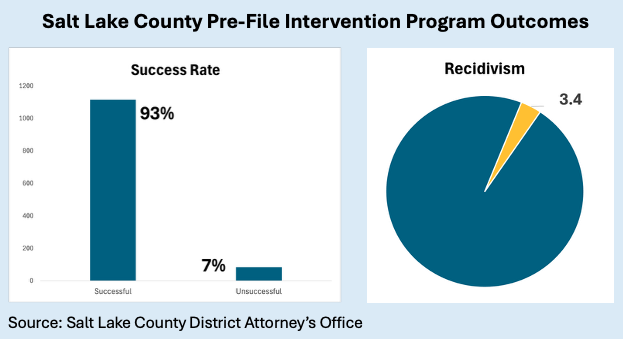
CPIP launched in 2019 and began formally tracking outcomes in 2020. Internal data show the program has maintained a successful closure rate above 90 percent, with a peak of 96 percent in 2021. The cases diverted through the program included a wide range of charges. Retail theft and drug possession make up the majority, but the program also handled 160 felony charges, with 135 at the third-degree level and 25 second-degree charges.
In 2025 alone, CPIP tracked approximately $35,000 in restitution returned to victims.
Notably, the recidivism rate of people who successfully complete the program is 3.4 percent. Salt Lake County DA Sim Gill emphasized these outcomes, stating, “It is possible to invest in criminal justice reform without compromising on public safety.”
The data show real success, but the human stories behind each number are equally profound.
In one case, a school employee had her credit card used without permission by a coworker. She didn’t want the person to go to jail, but she wanted to be made whole financially. CPIP helped make that happen.
Recently, a participant with high-functioning autism wrote to the judge who had placed him in the diversion program:
“I’d like to thank you for placing me in the diversion program…. I am progressing in my life and excelling beyond what I thought I could achieve. I feel very grateful…even though I have high-functioning autism, I learn very well and I learned to be a better man for myself and for my family and friends.”
In another case, a woman who lost her job due to addiction was enrolled in an intensive therapy program through CPIP. During treatment, she discovered that service to others in recovery was her true calling. She now works as a peer supporter at a treatment center.
These are the kinds of successes that can only be measured by the worth of a life restored.
Building on Existing Culture
Salt Lake County’s history of collaboration and culture of innovation made CPIP a natural fit. The county has operated a pretrial program for more than 50 years, establishing deep working relationships between the DA’s office and CJS. Leadership in both agencies share the belief that the system needs better off-ramps for low-risk and non-violent individuals.
“Our goal is to minimize contact with the system and not make things worse,”
Deputy District Attorney Jennifer Mitchell
No stranger to alternative approaches, the county is also home to one of the first juvenile drug courts in the country, along with a robust mental health court that has operated for more than 25 years.
Since its launch, the program has expanded from one case manager to three, and the DA’s office has assigned a dedicated attorney who can focus exclusively on CPIP cases. According to Mitchell, the district attorney hopes to eventually divert ten percent of all cases screened by the office.
A Message to Other Jurisdictions
Jacobsen and Mitchell’s advice to other jurisdictions is to start small. Don’t wait until everything is perfect, and don’t reinvent the wheel. Start with a pilot program, borrow from what other jurisdictions have done, and grow from there.
Both emphasized that collaboration is non-negotiable. Mitchell made a case for why prosecutor involvement isn’t just helpful, but structurally necessary. “Diversions can’t happen without prosecutor buy-in because prosecutors typically have full and exclusive discretion in the filing and dismissing of charges,” she said. “DA offices are constantly trying to manage growing caseloads. Diversion programs can take a chunk of those cases off the top and allow prosecutors to focus their time and energy on the cases and defendants that need it.”
Salt Lake County’s success has hinged on the willingness of multiple agencies to share information and caseloads, and trust each other’s judgment.
“No single agency is going to be successful starting up a program and growing something big on their own,” Jacobsen said. “We’re all dealing with the same clients and the same humans. We all want the same thing.”
Salt Lake County’s CPIP is proof that when the right partners come to the table committed to collaboration, the people who move through the system, and the communities they return to, are better for it.
As Jacobsen said, “You, the community, the courts—will all benefit.”