A yellow line marks the intake area to the Blue Earth County Jail in Mankato, Minnesota. Stepping over that line, in both the literal and symbolic senses, symbolizes a step deeper into the criminal legal system. For people with substance use disorders and mental health needs, crossing the line can make it more challenging to address the conditions that may have contributed to their contact with law enforcement in the first place.
The Yellow Line Project (YLP) seeks to prevent that step through robust collaboration among law enforcement, human services, and community-based providers.
Office-Involved Community Care Coordination
When people come into contact with law enforcement, The Yellow Line Project enables the timely identification of those in need. Referrals to the project are not limited to people suspected of a crime; they can also come, for example, after street interactions or welfare checks. While there are many pathways to referral, officers retain discretion over decisions about arrests and jail bookings.
The core idea of the project is that, regardless of how law enforcement interacts with someone, they can refer that person for a voluntary screening to determine eligibility for mental health or substance use treatment or for other social, economic, and housing supports. Blue Earth County’s success in developing and piloting this model convinced state legislators that it makes sense to match people with social services before, not after, they are booked into jail.
Minnesota now calls this approach Officer-Involved Community-Based Care Coordination. The legislation, passed several years ago, received bipartisan support and the backing of law enforcement and behavioral health groups. Counties that provide Officer-Involved Community-Based Care Coordination screen people for services and, if eligibility requirements are met, those services are reimbursed by the state for up to 60 days.
Eleven counties in Minnesota, including Blue Earth, currently provide Officer-Involved Community-based Care Coordination.
Screenings: Yellow Line’s Power
The founders of the Yellow Line Project learned that a voluntary personal screening is its most powerful tool. The initial screening is used to identify chemical or mental health concerns, and it can be done in the community, pre-booking, or in jail. Regardless of any pending charges, project staff build connections and empower people to identify what they need in the moment — it might be a pair of shoes, a place to sleep, a driver’s license, or health insurance.
Addressing these needs allows Yellow Line staff to build trust and help people move forward in a positive direction with coordinated care and referrals to services.
Screenings during business hours are conducted by a social worker (called a community-based coordinator), while after-hours screenings are conducted by the local mobile crisis services team.

Improving Outcomes
The Yellow Line Project is credited with reducing short-term recidivism and improving connections to services and supports. A 2023 study found that, compared to the baseline period and relative to similar nonparticipants, Yellow Line participants:
- Experienced a 17 percent reduction in their risk of future recidivism
- Were approximately 1.5 times more likely to use substance use disorder treatment services in the short term and less likely to use the emergency room for nonfatal overdoses
- Were 2 to 3 times more likely to use mental health treatment services for a full year after encountering the Yellow Line Project, and 3 times more likely to use intensive mental health services (e.g., hospitalizations)
- Were no more likely to use medications for opioid use disorder
“YLP was able to substantially reduce that greater risk of recidivism and bring it in line with the average rate of the matched group after exposure to the program. These findings are supported by a county-wide analysis that shows a similar reduction in recidivism in Blue Earth County, relative to peer counties which have not implemented a program like [Yellow Line Project],” according to the study authors.
Collaboration, Communication, Relationships
Over the years, Blue Earth County stakeholders have built a culture of trust through deep collaboration, communication, and relationships. A multidisciplinary Collaborative Outreach Team meets monthly to consult and educate members about community resources. The city of Mankato, the county seat, is home to Minnesota State University, Mankato, and several other colleges and universities. Over time, these academic institutions, along with the local housing authority, have also been invited to outreach meetings, and family members sometimes come to ask how they can help their loved ones.
“We’ve had family members come to the Collaborative Outreach. So, law enforcement has had interactions with individuals, and they have family that are saying, ‘What can we do to help our loved one?’” said Angela Youngerberg, former Blue Earth County Human Services Director of Business Operations, who was involved in the founding of The Yellow Line Project. “We don’t have a perfect system, but at least they feel heard and maybe will walk away with another resource or two in their back pocket or a connection.”
Blue Earth County’s model includes city, county, and state agencies along with community-based providers. These include:
- City of Mankato Police Department
- Blue Earth County Sheriff’s Office
- Blue Earth County Attorney’s Office
- Blue Earth County Human Services and the Mental Health Center
- Mayo Clinic Health Systems
- Horizon Homes, a multi-disciplinary mental health services provider, which includes the Crisis Center and Mobile Crisis Team
- Brown County Evaluation Center (a non-hospital detox facility)
- Several other community providers, including shelters, housing providers, and academic institutions
Addressing Complex Issues Effectively
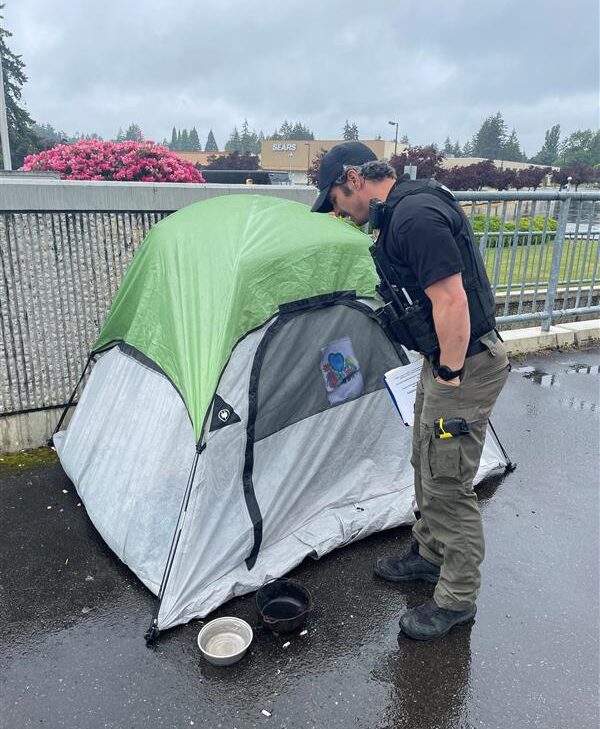
Criminal legal systems across the country are increasingly recognizing that collaboration and communication are vital in their efforts to address complex community issues. In Blue Earth County, the community-based coordinators work with law enforcement when officers report receiving repeated calls about a particular person. The coordinators might meet with the individual directly or recommend that officers engage the mobile crisis team. They regularly ride along with local law enforcement officials, allowing them to build relationships with the officers, develop a shared understanding of the work, and even co-respond if a call comes in during that time.
Julie Stevermer, who recently retired as Blue Earth County Human Services Supervisor, recounted the story of a young man who struggled with substance use disorder. He refused voluntary services, but was frequently entering both the jail, on low-level charges, and the local detox facility.
Law enforcement officers and members of the Yellow Line Project grew concerned about the likelihood of self-harm. Project staff coordinated the documentation required to meet the standard for a court-ordered involuntary civil commitment for treatment, including law enforcement contacts, 911 calls, and medical documentation from detox visits.
“This level of care coordination was very helpful,” Stevermer said. “That’s where we look at our community resources working collectively together with somebody who’s really at risk.”
Continuous Improvement
Stevermer says that, since the 2023 study, the Yellow Line Project continues to focus on improving outcomes. Staff are now:
- Doing more street-level responses than ever before, including weekly ride-alongs with law enforcement
- Engaging more with community providers through ride-alongs and shelter engagement as ways to deliver timely services, rather than waiting until people arrive at jail
- Working with people as they are being released from jail
The Yellow Line Project also reports that while the number of screenings has declined, caseloads have increased. In other words, fewer people are going to jail, and more people are accepting services.
“Our whole goal is to prevent people from going back to jail for issues that involve behavioral health, either chemical or behavioral,” Stevermer said.